


Page 228 - The Guide To Sarawak
P. 228
 226 NATURE
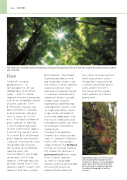
  The rainforest, Sarawak’s greatest natural asset and a biological phenomenon that has shaped the state’s history, culture and economy.
Flora
Sarawak’s unique geodiversity – its remarkable mix of soil, topography and terrain types – and its stable tropical climate have given rise to an incredible wealth of plant species. Over 8,000 plant species are documented in Sarawak, and researchers believe that as many as 12,000 exist. The total number of plant species in Borneo
is estimated at between 13,000 and 15,000 (about 5-6% of the world’s total). Thus over 80% of Borneo plant species are found in Sarawak, making the state the perfect destination for anyone fascinated by tropical plant life.
The rainforests are made up of over 2,000 tree species, interspersed with orchids (more than 1,000 species), palms (nearly 300 species) and ferns (nearly
800 species). The Mixed Dipterocarp forests and
old secondary forests are the richest in plant species, and also contain most commercial species found in Sarawak. Economically important plants include timber trees (mostly euphorbias, dipterocarps and legumes), palms such as sago and rattan, and a huge variety of endemic fruits and vegetables. For the future, medicinal and therapeutic plants are likely to increase in economic importance.
The plants of greatest interest to visitors can be seen in Sarawak’s National Parks (NP). The world’s largest flower, the Rafflesia, thrives at Gunung Gading NP. Kubah NP features a palmarium trail with more than 50 palm species,
as well as wild ginger flowers and the remarkable Amorphophyllallus or corpse flower. Bako NP
lays claim to seven distinct plant ecosystems and is the perfect showcase for
a variety of pitcher plants, and Lambir Hills NP is
the home of the world’s most species rich forest ecosystem.
     Nepenthes Lowii, one of the most spectacular pitcher plant species endemic to Borneo. Its remarkably large upper pitcher is believed to have evolved to capture bird and treeshrew droppings as well as insects.


