


Page 251 - The Guide To Sarawak
P. 251
THE GUIDE TO SARAWAK 249
  Melons
Melons are grown principally for domestic consumption; every market in Sarawak has stalls
piled high with delicious watermelons and honeydew melons, mostly produced
by small-scale growers. Serious commercial planting of melons is in its infancy, with a number of growers in the Kuching area venturing into the cultivation of rock melons, which are more suitable for the export market.
Durians
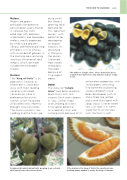
The “king of fruits” is as popular in Sarawak as elsewhere in Southeast Asia, with most leading varieties cultivated. Sarawakians have a preference for durian nyekak, a rich-flavoured wild variety only recently brought into cultivation. The durian nyekak is low yielding and the fruits are
Commercial hybrid durian fruits growing in an orchard. If the durian is the king of fruits, the small and low- Wild varieties produce fewer fruits. yielding durian nyekak is surely the king of durians.
quite small, but there is growing local demand for this “gourmet durian”, with potential for developing an export industry. As elsewhere
in Malaysia, the durian is banned from hotels and public transport because of its pungent odour.
Dabai
The dabai or “jungle olive”. These fruits have been soaked in hot water for a few minutes and are ready to eat.
antioxidant properties, with smallholders venturing
into commercial planting. Various products have been developed, such as dabai fried rice, pitted dabai and dabai goat milk soap. Dabai is never eaten raw; just soak it in warm water for 15-20 minutes
     The dabai or “jungle
olive” tree bears purplish-
black fruits with rich,
savoury flesh and is grown
in Sibu, Sarikei, Kapit
and Limbang divisions.
It has great potential
as a specialty fruit and
nutraceutical because of its   until the flesh is soft.


