


Page 95 - The Guide To Sarawak
P. 95
THE GUIDE TO SARAWAK
93
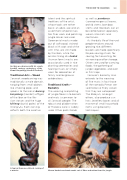
       An Iban woodcarver with his ornate hornbill carving, centrepiece of the Gawai Kenyalang (Hornbill Festival).
Traditional Arts – Wood
Sarawak woodcarving was traditionally a male domain, ranging from small objects like smoking pipes and spoons to the iconic burung kenyalang (hornbill) effigies of the Iban or the life-
size statues and the huge klirieng (burial poles) of the Orang Ulu. Each carving reflects both the creative
A typical Iban wood block carving of a warrior.
talent and the spiritual traditions of the artist, whose tools are rather basic: an adze, axe and an assortment of penknives. For finer work and polishing jungle leaves are used. Ceremonial masks made out of softwood, stained black with soot and white with lime, are still made
by the Iban, while the ornate Orang Ulu hudok (human form) masks are occasionally used in rice planting ceremonies and healing rituals, or simply worn for decoration at family and longhouse celebrations.
Traditional Crafts – Basketry
The weaving and plaiting of jungle fibres into baskets and mats is common to
all Sarawak people. The robust and pliable rattan
or Malacca cane is widely used. Other palm fronds
as well as pandanus (screwpine genus) leaves, orchid stems, bamboo stems and tree-bark can all be combined or separately woven into mats and containers.
As the daily life of the rural people revolves around growing rice, different baskets are made specifically for pre-sowing rituals, for sowing, for harvesting, for winnowing and for storage. Others are used for carrying foods, the gathering of jungle vegetables, and even as fish traps.
Sarawak’s basketry also extends to the weaving
of fine mats; in fact those of the nomadic Penan are said to be so finely woven that they are waterproof. The Bidayuh, amongst others, also produce sun hats, jewellery boxes and all manner of small household items using basketry techniques.
   Woven baskets and mats made out of fiber and rattan from the jungle.


