


Page 204 - Westport Guide To Malaysia
P. 204
 196 AGRICULTURE
   Transforming The Green Economy
The agriculture industry
is vitally important to Malaysia, providing food security, putting nutritious food on our dinner tables, playing a crucial role
in rural development, creating employment and improving balance of trade. It is divided into two main sub-sectors, industrial commodities and agrofood. The Ministry of Agriculture and Food Industries (MAFI) oversees the agrofood sub sector while the Ministry of Plantation Industries and Commodities is responsible for plantation crops such
as pepper, palm oil, rubber and cocoa.
As of 2018, the agriculture sector contributed RM99.5 billion, or 7.5%, to Malaysia’s
GDP. It employs more
than 1.5 million people, approximately 11% of
the nation’s workforce. Almost 26% of Malaysia’s total land area is used for agricultural purposes, of which around 2.7% is arable land and the balance is mainly under permanent crops. Oil palm contributes 46.6% to the industry’s GDP, followed by livestock, fisheries and rubber at 11.4%, 10.5% and 7.3% respectively. This chapter deals with the agrofood sub-sector; plantation crops are described in the next chapter, Plantations & Commodities.
Agriculture & Food Industries
Rice remains the staple crop, with over half a million hectares under cultivation, producing around 2.5 million tonnes annually,
or 70% of the country’s
requirements. The state of Kedah is the biggest single producer, accounting for almost half of Malaysia’s annual output. New rice varieties are continuously developed to offer higher yield, early maturation and better disease and climate resistance, as well as niche red rice varieties with high fibre and mineral content.
Banana is amongst the dominant tropical fruits cultivated in Malaysia, which produces around 350,000 tonnes annually with local varieties the most popular. However,
the Cavendish banana’s market share is increasing due to its better shelf life and higher resilience during transportation. The durian industry is booming, due to both local and international demand (mostly from China), with most Malaysian orchards growing the popular Musang King
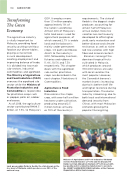
      Lush green paddy fields in Kedah, the state known as the rice bowl of Malaysia, which produces over 50% of the national crop.
Minister of Agriculture and Food Industries YB Datuk Seri Dr. Ronald Kiandee (2nd left) and his Deputy YB Datuk Seri Haji Ahmad bin Hamzah (3rd left) meet with key paddy and rice industry stakeholders to promote the SMART LARGE RICE FIELD initiative at the Farmers Organization HQ in Kuala Lumpur.


