


Page 369 - Westport Guide To Malaysia
P. 369
THE GUIDE TO MALAYSIA 361
  more than RM2.5 million are 17% for the first RM600,000 and 24% for the remainder of the balance, while the current rate for paid-up capital of more than RM2.5 million is 24%.
In 2015 a Goods and Services Tax (GST) was introduced at a level of 6% to replace the previous 10% Sales Tax in a move towards a system of indirect taxation. In June 2018 all items under the GST were zero-rated to counter rising prices and provide relief for the lower- income population. GST was replaced from September 2018 with a new Sales & Service Tax with most goods taxed at between 5% and 10% and services at 6%. Certain items essential for consumers or industries
are rated lower or even at zero%.
Tax incentives, both direct and indirect, are provided for in the Promotion of Investments Act 1986, Income Tax Act 1967, Customs Act 1967, Excise Act 1976 and Free Zones Act 1990. These Acts
cover investments in the manufacturing, agriculture, tourism (including hotel) and approved services sectors as well as R&D, training and environmental protection activities. Direct tax incentives grant partial or total relief from income tax payment for a specified period, while indirect
tax incentives are in the form of exemptions from import duty and excise
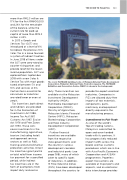
The iconic MATRADE building, home of Malaysia External Trade Development Corporation, Malaysia’s National Trade Promotion Agency. The MATRADE Exhibition and Convention Centre (MECC) is shown in the background.
   duty. These incentives are available via the Malaysian Investment Development Authority (MIDA), Multimedia Development Corporation (MDEC), Ministry of Agriculture, Malaysian Islamic Financial Centre (MIFC), Malaysian Biotechnology Corporation and Halal Industry Development Corporation (HDC).
Further financial incentives are available from the respective
state governments and
the country's various development corridors
and industrial parks (see page 368), many of which cater to specific types
of industries. In addition,
13 Free Industrial Zones (FIZs) have been developed throughout the country to
provide for export-oriented industries. Companies in FIZs are allowed duty-free imports of raw materials, components, parts, machinery and equipment directly required in the manufacturing process.
Commitment to Fair Trade
As one of the world's Top-25 trading nations, Malaysia is committed to open and even-handed trade with its partners. It has progressively reduced import tariffs across the board, and has customs procedures which are in line with Asia-Pacific Economic Cooperation and ASEAN programmes. Paperless export transactions are available at major ports and airports, and an electronic data interchange provides


