


Page 399 - Westport Guide To Malaysia
P. 399
THE GUIDE TO MALAYSIA 391
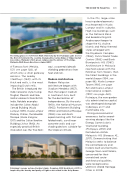
     The living grass roof of Heriot Watt University by the Putrajaya Lake shore is the first of its kind in the country. Designed by Serina Hijjas of Hijjas Kasturi Associates, Malaysia’s first green campus was the winner of The Edge Malaysia-PAM Green Excellence Award 2017.
In the 70s, large-scale housing developments mushroomed in Kuala Lumpur and its suburbs. High rise buildings such as the National Bank
and broadcasting HQ Angkasapuri began to shape the KL skyline. Islamic and Malay themed styles emerged with
the Dayabumi Complex (1984), Putra World Trade Centre (1985) and Bank Bumiputra’s HQ (1987). Architecture in Malaysia reached a peak with the Petronas Twin Towers, then the tallest buildings in the world (begun 1994, see page 88), Kuala Lumpur Tower (1995, see page
92) and Kuala Lumpur International Airport, (1997, see page 422). Putrajaya, the new garden city administrative capital, was developed alongside Cyberjaya, an IT and multimedia city.
Rising environmental awareness led to award- winning designs like the Energy Commission’s ‘Diamond’ building (Putrajaya, 2010) and Pertubuhan Akitek Malaysia’s HQ (Bangsar, KL, 2017). Demonstrating that Malaysia seeks to balance the contemporary and historic built environments, George Town and Melaka, conserved for their unmatched socio- architectural qualities,
were recognised as UNESCO World Heritage Cities in 2008.
A'Famosa fort (Melaka, 1511, see page 102), of which only a small gateway remains. The nearby Stadthuys (1641), with its thick red walls, is the most imposing Dutch relic.
The British introduced the Indo-Saracenic style, fusing Mughal, Moorish and Neo- Gothic elements from British India. Notable examples include the Sultan Abdul Samad Building (Kuala Lumpur, 1897), Kuala Lumpur Railway Station, the Ubudiah Mosque (Kuala Kangsar, 1917) and the Sultan Ibrahim Building (Johor, 1940). An especially practical British innovation was the ‘five-foot-
way’, a covered sidewalk shielding pedestrians from heat and rain.
Modern Architecture
Modern Malaysian architecture began with Stadium Merdeka (1957), then the largest stadium
in Southeast Asia, built
for the declaration of independence. By the early 1960s, the National Museum (1963), Parliament Building (1963) and National Mosque (1965) saw architects experimenting with flat and folded roofs, curvilinear concrete walls and sun- shading devices suitable for the tropical climate.
    Putrajaya’s serene yet spectacular Islamic Complex (RSP Architects, 2017) is inspired by the beauty and purity of light as described in the Holy Quran.


