


Page 16 - The Guide To Sarawak
P. 16
 14
INTRODUCTION TO MALAYSIA
 which evolved into the Federation of Malaya in 1948, while Singapore, Sabah and Sarawak became Crown Colonies.
Independence for Malaya came in 1957 following amicable negotiations between Britain and a Malayan delegation led
by Tunku Abdul Rahman Putra Al-Haj (subsequently Malaya’s first Prime Minister). Merdeka (Independence) was declared in Coronation Park, Melaka, and proclaimed at Merdeka Stadium in Kuala Lumpur on 31st August, 1957.
In 1963, Malaya was expanded through a merger with the former Crown Colonies of Sabah, Sarawak, and Singapore
to form Malaysia. In 1965, however, Singapore ceased to be part of Malaysia
and became a separate, independent country.
The People
Malaysia’s population
(2014) is approximately
30 million. The majority
of Malaysians are Malay- Muslim Bumiputeras who make up about 55% of the population, followed by Chinese (24%), Non-Muslim Bumiputeras (13%) Indians (7%), and Others (1%).
Bumiputeras (“sons of
the soil”) is the official term for people of Malay and/or indigenous ethnicity, who enjoy certain privileges designed to upgrade their economic status. The non- Muslim Bumiputeras consist of Orang Asli aboriginal communities from West Malaysia; Kadazanduzun, Bajau, Murut and other indigenous groups from Sabah, and Iban, Bidayuh, Melanau, Orang Ulu
and other indigenous groups from Sarawak.
The national language is Bahasa Malaysia. English is also widely spoken along with many Chinese, Indian and native dialects.
Religion
Malaysia is a modern Islamic country; Islam is professed by over 60% of the population, and is the official religion. Other faiths however, such as Buddhism, Christianity, Hinduism, Confucianism, Taoism, and other native beliefs are freely practiced; temples, mosques and churches sit comfortably side by side.
Religious faith has given Malaysia some of its
finest landmarks. Notable modern mosques include the National Mosque, the Blue Mosque in Shah Alam (the largest in Malaysia), the Putrajaya Mosque and the Crystal Mosque in Kuala Terengganu. Historic mosques include the Jamek (Friday) Mosque
in Kuala Lumpur, the exquisite Ubudiah Mosque in Kuala Kangsar and the artfully concealed Indian Mosque in Kuching.
Major Hindu monuments include the Batu Caves temple complex in Selangor, the Sri Mahamariamman Temple in Penang and the Sri Sundararaja Perumal Temple in Klang. Buddhism has contributed the Wat Machimmaran in Kelantan, (with the largest sitting Buddha in Southeast
Asia), as well as the Kek Lok Si Temple in Penang, amongst others.
The famous Snake Temple in Penang and the ancient Cheng Hoong Teng Temple in Melaka stand out amongst the many Chinese
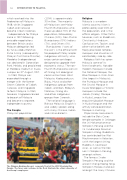
      The Malayan Banking Group’s corporate float at the 2013 Merdeka Day Parade. The faces and costumes in the float illustrate the ethnic diversity of the Group’s employees.


