


Page 231 - The Guide To Sarawak
P. 231
THE GUIDE TO SARAWAK 229
  Fauna
The enormous variety
of flora creates suitable habitats for an astonishing number of animal
species. The total number (including those yet undiscovered) is probably between 10,000 and 12,000, with three new species discovered in Borneo every month. Unlike plants, animals
are highly mobile; it is estimated that over 90% of Borneo animal species are found in Sarawak.
Invertebrates
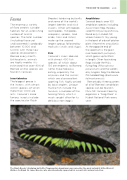
The biggest group is the insects, with almost 4,000 species, of which more than 1,000 are ants. Sarawak’s more famous insects include the spectacular Rajah
Brooke’s birdwing butterfly and some of the world’s largest beetles and stick insects. Other arthropods (centipedes, millipedes, scorpions, spiders, land crabs, ticks and mites) make up the second largest group, followed by mollusks (snails and slugs).
Fish
Sarawak’s rivers abound with almost 400 fish species, of which about 150 are endemic to Borneo. Some make fabulous eating, especially the empurau and the semah; which are also excellent sporting fish, highly prized by local anglers. Unique marine fish include the terubok, a member of the herring family which is much sought after for its delicious roe (eggs).
Amphibians
Sarawak boasts over 100 amphibian species, including Asia’s tiniest frog, the pea- sized Microhyla nepenthicola, found only in Kubah NP, where it rears its tiny young in the bowl of a dwarf pitcher plant (Nepenthes ampullaria). At the opposite end of
the spectrum is the giant river toad (Bufo juxtasper), which grows up to 30cm
in length. Other fascinating frogs include the Mulu
flying frog (Rhacophorus penanorum) and the world’s only lungless frog, the Borneo flat-headed frog (Barbourula kalimantanensis).
Remarkably, three quarters of all of Borneo’s amphibian species can be found in Mulu NP. Sarawak Forestry organizes a “Frog Race” in Kubah National Park every year.
       The Rajah Brooke’s birdwing butterfly (Trogonoptera brookiana) was named by the great naturalist Alfred Russell Wallace for Rajah Sir James Brooke, who wholeheartedly supported his research into natural selection.


