


Page 255 - The Guide To Sarawak
P. 255
THE GUIDE TO SARAWAK 253
  ARABLE FARMING - RICE
The main arable crop in Sarawak is rice, the only grain grown commercially
in the state. Hill rice, grown by indigenous people under shifting cultivation, uses the greatest land area, 12% of the state, and yields 85% of the harvest. However, due
to hill rice’s low yields and the introduction of valuable cash crops, fewer people are planting it.
A notable exception is Traditional Red Rice (TRR), enjoying increased demand as “boutique rice” because of its attractive colour, distinctive flavour and high antioxidant content. A pilot project, sponsored by the Department of Agriculture and Nestle Malaysia, to produce organically grown TRR commercially, involves over a hundred local Bidayuh farmers in Serikin (Bau), Sekeduk-Chupak (Siburan) and Paya Payang (Serian). Nestle plans to use the TRR in premium baby
foods and is researching other possible uses.
To offset the decline in hill rice production, the Sarawak government has identified some 58,000 hectares
of land in Samarahan, Sri Aman, Sarikei and Mukah for the commercial planting of paddy, using estate
style planting techniques. Malaysia produces about 73% of its rice requirement and it is hoped that estate planting in Sarawak will reduce rice imports. Sarawak’s most famous irrigated rice is the delicate and fragrant Beras Bario, grown by the Kelabit
and Lun Bawang farmers of the Bario Highlands and Ba’Kelalan. Due to growing demand, and to protect the community’s unique “trademark”, the Department of Agriculture introduced the Bario Rice Certification Scheme in 2005 to preserve quality and authenticity.
Bario Rice is also protected
Bario rice, one of the world’s finest rice varieties, is nowadays protected under Geographical Indication (GI)
under Geographical Indication (GI), as are two other high quality varieties; Sarawak Biris Rice and Sarawak Bajong Rice. Beras Biris, a fragrant rice with a smooth and glossy texture, is cultivated in the Simunjan and Samarahan areas. Beras Bajong, an aromatic purple rice with distinctive taste and texture, is planted by traditional farmers at Lubok Nibong. GI protection ensures authenticity, consistency and quality of these products.
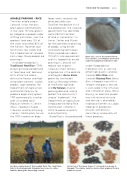
         An Iban couple inspect their paddy field. The small farm huts in the background (langkau) are home to entire families during the harvesting season.
Just a few of the many types of coloured rice grown in Sarawak. The darker varieties derive their pigment from a symbiotic yeast.


