


Page 58 - The Guide To Sarawak
P. 58
 56
THE PEOPLE
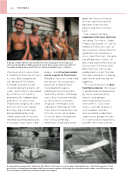
    A group of Iban farmers (and a farmer-to-be) relaxing at their longhouse on the Lemanak River. While practical shorts have replaced to loin-cloth for everyday working wear, their tattoos remain unchanged over centuries.
gods for their assistance, as they see little conflict between their ancient beliefs and the Christian faith.
The majority of Iban
celebrate Christian festivals
including Christmas, Good Friday and Easter. As well as traditional festivals such as Gawai Dayak, Gawai Burong (bird festival) and Gawai Antu (spirit festival). Despite the difference in faiths, all Iban help each other during Gawai and Christmas and both festivals are usually celebrated in most families. The Ibans believe in helping each other and having fun together.
On such festivals the Iban traditional dance, the ngajat, is performed accompanied by taboh and gendang (drums and gongs),
their traditional musical instruments. Tuak (rice wine) is served to guests, with modern versions
also available made from sugar-cane, ginger or corn. It is normal Iban hospitality to offer their rice wine or
structure which varies from a handful of bilek to as many as sixty. Iban longhouses can be over 100 meters
in length and are usually situated along the banks of rivers. Each bilek is occupied by a family unit which is economically independent and farms its own land. Traditional longhouses were built on stilts with wood,
but they are increasingly being replaced by two- storey concrete structures resembling terraced houses. In the past most Iban were
pagan, and ritual pervaded every aspect of their lives. Religious festivals were held for almost any auspicious occasion and practices included bird augury, reading of animal entrails and many others. Although many Iban have converted to Christianity (Catholic, Anglican, Methodist and Sidang Injil Borneo or SIB) their animistic practices are still very much alive today. Christian Iban still perform the miring (offering) ceremony invoking ancient
      A young Iban woman spins yarn from the fibres of the taya or cotton plant (Gossypium sp.). The finished yarn is then woven into a stunning pua kumbu textile by a master weaver. Although these pictures were taken over 100 years ago, the techniques shown have remained quite unchanged.


