


Page 209 - Westport Guide To Malaysia
P. 209
THE GUIDE TO MALAYSIA 201
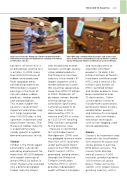
      Inspectors from the Malaysian Timber Industry Board’s Industrial Development Department carrying out timber certification checks.
hectares, of which 93% is smallholdings and the rest is estates. In 2018, more than 600,000 tonnes of rubber were produced from tappable areas, contributing more than RM40 billion in export earnings in the form of natural rubber, rubber products, rubber woods and wood products.
This makes rubber the country’s second most important plantation crop, as it helps to provide
over 500,000 jobs in the upstream, midstream and downstream sectors. The Malaysian rubber industry is expected to enjoy steady growth as global demand continues to rise.
Timber
Timber is the third largest commodity sub-sector, providing employment for more than 165,000 people with export earnings of almost RM22.02 billion in 2020. Malaysia has evolved into a prominent global timber industry player
with established market networks and high-quality value-added products. The Malaysian furniture industry is the world’s 6th largest exporter, with a market presence in over 160 countries generating more than RM12.57 billion in 2020. Producers of plywood, veneer, boards and mouldings also contribute significantly. Cumulative exports of sawn timber in 2020 decreased by 27% in volume and 29% in value to 1,323,501 m3 totalling RM2.4 billion compared to the previous year.
Malaysia is committed
to Sustainable Forest Management (SFM) and has pledged to retain more than 50% of its land area under permanent forest cover at the 1992 UN Rio Earth Summit. SFM is promoted, among others, through the Malaysian Timber Certification Scheme (MTCS), which provides independent audits of forest managers
and manufacturers or exporters of timber products. To date, 5.62 million hectares of forests have been certified under MTCS and a total of 2.62 million cubic meters of MTCS-certified timber and timber products have been exported to over
72 destinations. Other sustainability initiatives include forest plantations, permanent forest estates, rehabilitation projects and community managed forests, with low-impact extraction techniques such as heli-logging used where appropriate.
Cocoa
Cocoa is an important crop, especially for smallholders, with exports of cocoa and cocoa products earning RM6 billion annually. The current total planted
area of cocoa is 5,900 hectares, producing about 1,000 tonnes of cocoa beans. Malaysia has the world’s sixth largest cocoa grinding industry, with a
The PEFC tag confirms that this table and chairs have been made from sustainably produced timber certified by the Malaysian Timber Certification Council (MTCC).


