


Page 384 - Westport Guide To Malaysia
P. 384
 376 USEFUL INFORMATION
 Malaysia’s Energy Landscape
Since independence, Malaysia’s economy has diversified from agriculture and commodity-based, to manufacturing and services
sectors, which in turn bolstered the country’s energy intensity, particularly oil and gas (O&G).
A pillar to the nation’s economy,
the O&G industry has been a key contributor to the Gross Domestic Product (GDP)
since the 1980s, contributing 20
per cent in 2020.
The O&G sub- sector encompasses
upstream (exploration and production), midstream (processing, storage and transportation of oil and gas to refineries and end- users) and downstream (refining and distributing of petroleum products).
The country’s oil and gas reserves are the fourth and fifth largest respectively
in the Asia-Pacific region, with 3.6 billion barrels of proven oil reserves and 42 trillion cubic feet of proven natural gas reserves.
Being a resource-rich nation, Malaysia’s dynamic O&G industry is active across the entire value chain – from upstream to downstream. Besides exploration and production, sales of crude oil and natural gas, the country has been one of the largest exporters of liquefied natural gas (LNG) globally since
the 1990s and is ranked
fourth largest in 2020 after USA, Australia and Qatar.
More recently, the Malaysian government has expanded into alternative and renewable energy (RE) sources. RE has largely come from hydropower plants in Peninsular Malaysia as well as Sabah and Sarawak.
The share of hydropower
in the country’s electricity generation is around 11 per cent, but with less than 20 per cent of the technically feasible generation potential utilised to date, there is significant expansion already in the planning stages or under development.
The hydropower sector
has in the past largely been concentrated in Peninsular Malaysia, but due to its high rainfall and geography, the state of Sarawak on the island of Borneo, is expected to experience the lion’s share
of new developments. It
is forecasted that 60 per
cent of Sarawak’s power generation is to be sourced from hydropower, up from
35 per cent in 2012.
Hydrogen has also emerged as an important part of the clean energy mix in ensuring a sustainable future as it emits zero CO2 when used. This makes it a critical energy vector to decarbonise the world, complementing other clean energy sources.
Although a small molecule, the versatility of hydrogen as fuel, heat source and feedstock allow for the demand to further grow
and be used in many
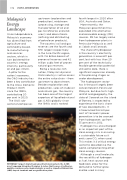
   PETRONAS’ largest downstream greenfield development, the 6,303- acre Pengerang Integrated Complex in Johor, that houses oil refineries, naphtha crackers, petrochemical plants as well as Liquefied Natural Gas (LNG) import terminals and a regasification plant.


