


Page 385 - Westport Guide To Malaysia
P. 385
THE GUIDE TO MALAYSIA 377
  other sectors such as transport, industries and power generation.
Towards this end, Petroliam Nasional Berhad (PETRONAS) has been involved in producing grey and blue hydrogen as well as working with relevant stakeholders to explore
the production of green hydrogen. In Kuching, Sarawak Energy Bhd (SEB) has launched Southeast Asia’s first Integrated Hydrogen Production Plant and Refueling Station, which is currently powering a small fleet of free-to-ride hydrogen fuel cell buses that service various routes in and around the city.
Malaysia’s Energy Outlook
Malaysia’s energy demand is projected to double between 2015 and 2040. Amidst accelerating energy transition, gas
and renewable will play a bigger role in meeting the global energy needs.
Gas is more resilient
than oil as growing
share of electric vehicles (EVs), rising demand for sustainable fuels and increasing efficiency of the transport sector would erode the consumption of oil. Furthermore, the RE technology is expected
to become cheaper
and more accessible, enabling the country’s further growth into solar energy and hydro.
As part of its energy transition plans for 2040, Malaysia is aiming to have 31 per cent of
its total electricity mix being contributed by RE by 2025. It will then be scaled up to 40 per cent
in 2035, according to the Ministry of Energy and Natural Resources (KeTSA) that was conveyed at
The Special Meeting
of ASEAN Ministers on Energy and the Minister of Economy, Trade and Industry of Japan.
Of the 31 per cent RE
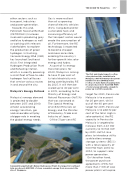
The first and single largest rooftop solar photovoltaic installation in Malaysia, a 685-kilowatt peak system installed on the 9,000sq metre rooftop of Suria KLCC shopping mall. It can produce more than 600 MWh of solar energy annually, enough to power up to 250 households.
target for 2025, Peninsular Malaysia is to account
for 26 per cent, whilst
out of the 40 per cent target for 2035, Peninsular Malaysia is to add 32 per cent of the total. High in solar potential, the RE capacity in Peninsular Malaysia is targeted to increase from 4.43 GW currently to 10.944 GW
by 2035. KeTSA also plans to introduce utility scale battery energy storage systems (BESS) with a total capacity of 500 MW from 2030 to 2034, to support solar power generation.
On the other hand, the power purchase agreements (PPA) for more than 7 GW of coal power plants will expire
       Sarawak Energy Berhad’s Bakun Hydropower Plant, the largest in Southeast Asia, produces 2,400 MW of clean, renewable energy from a reservoir the size of Singapore.


