


Page 234 - The Guide To Sarawak
P. 234
 232 NATURE
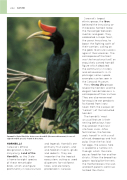
    Sarawak’s State Bird, the rhinoceros hornbill (Buceros rhinoceros) is one of eight hornbill species found in the state.
Sarawak’s largest
ethnic group, the Iban, believed the kenyalang or rhinoceros hornbill to be the messenger between mortals and gods. They celebrated a major feast, the gawai kenyalang, to boost the fighting spirit of their warriors, calling on the gods to ensure success against their enemies. The centerpiece of the feast was the kenyalang itself, an exquisitely carved hornbill figure which depicted
the community’s history and achievements in its plumage; some superb examples can be seen in the Sarawak Museum.
Many Orang Ulu groups revere the hornbill, and the elegant hornbill dance is a centerpiece of their culture. They are also renowned
for exquisite ear pendants fashioned from ivory taken from the casque (or “helmet”) of the helmeted hornbill.
The hornbills’ most unusual feature is their nesting behaviour, how they protect their nest
site from rivals. After fertilization, the female seals herself in with a wall of mud, droppings and fruit pulp. Once she has laid
her eggs, the access hole
is sealed to a narrow slit, through which the male passes food for her and her chicks. When the brood has grown too big for the nest, the mother breaks the wall, and both parents continue to feed the chicks.
HORNBILLS
Sarawak’s official designation is Bumi Kenyalang, Land of the Hornbills, as the State
is home to eight species
of these remarkable
birds, which also figure prominently in local culture
and legends. Hornbills are primarily fruit eaters, and also feed on insects, grubs and rodents. They are important to the tropical ecosystem, acting as seed dispersers for rainforest trees, and are totally protected in Sarawak


