


Page 235 - The Guide To Sarawak
P. 235
THE GUIDE TO SARAWAK 233
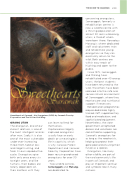
     Sweethearts of Sarawak - the Orangutans (2010) by Sarawak Forestry Corporation and Tan Sri Lim Kok Wing.
conserving orangutans. Semenggoh, formerly a rehabilitation centre, is now a wildlife centre with
a thriving population of almost 30 semi-wild orang utans, a third of whom were born there. Nowadays Matang is where dedicated staff and volunteers train and rehabilitate young orangutans so they can eventually return to the wild. Both centres are within easy reach of Kuching and open to the public.
Since 1975, Semenggoh and Matang have rehabilitated over 40 orang utans; the best students have been returned to the wild. The others have been released into the safe and secure natural environment of Semenggoh, where they receive care and nutritional support if necessary.
Rehabilitation programmes require dedicated, highly trained staff, supplementary food and medication, and sophisticated equipment. Nevertheless, the state government, enlightened donors and volunteers are committed to supporting Sarawak’s orangutans for
as long as the need exists, helping to protect their
gene pool and ensuring their future as a species.
Orangutans, like many other wildlife, are part of the rural community’s life in parts of Sarawak, and play an important spiritual and symbolic role in many cultures.
ORANG UTAN
The orangutan, one of our closest relatives, is one of the most intelligent animals after man. Sadly, it is also one of the most vulnerable, under ever increasing threat from habitat loss and illegal hunting, and from its own reproductive cycle. Orangutans give birth only once every six
to eight years, and like humans, their babies are totally dependent on their mothers until they
can learn to fend for themselves.
Orphaned or illegally captured orangutans usually face an early death or a meaningless life in captivity, which
is why Sarawak Forest Department and Sarawak Forestry Corporation have been rescuing orphaned orangutans for over 30 years.
Two wildlife centres, Semenggoh and Matang, are dedicated to


