


Page 30 - The Guide To Sarawak
P. 30
 28
INTRODUCTION TO THE STATE OF SARAWAK
 of Malaysia (the others being Peninsular Malaysia and Sabah) and therefore enjoys a great deal of political autonomy. The British legacy is ever- present, in the form of a self-governing parliamentary democracy, an independent legal system, strong institutions, three-tier educational system, rule- of-law, and a professional Civil Service headed by a State Secretary. English is very widely spoken and cars drive on the left like the rest of Malaysia.
The state has enjoyed political stability and great progress under former
Chief Minister Tun Pehin Sri Haji Abdul Taib Mahmud. The longest serving state leader in Malaysia, Taib celebrated 50 years in active politics in 2013. His “Politics of Development” have changed local mindsets
and transformed Sarawak
into an open, dynamic, business-friendly economy attractive to both local and overseas investors. Taib was succeeded as Chief Minister by Special Functions Minister Tan Sri Datuk Patinggi Haji Adenan bin Haji Satem on 1st March 2014. Chief Minister Adenan has pledged to continue Taib’s “Politics of Development”.
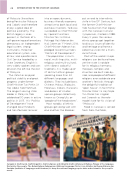
The population is multi- racial, multi-linguistic, multi- religious and multi-cultural, with vibrant, colourful traditions. It is made up of 27 distinct ethnic groups speaking more than 40 different languages and dialects. They include Ibans, Chinese, Malays, Bidayuhs, Melanaus, Indians, Eurasians and dozens of smaller upriver groups collectively known as Orang Ulu, or “people of the headwaters”.
Most notably, all ethnic groups get along well with one another; the Brookes
put an end to inter-ethnic strife in the 19th Century, but the former Chief Minister Taib has built on that legacy with the Sarawak Cultural Symposium, started in 1988. Every 5 years the various ethnic groups get together to discuss issues of identity and heritage and frame a collective vision for a multi- racial future.
Most of the world’s major religions can be found here, yet the state is notable
for its religious harmony; mosques, temples and churches are built side-by- side, and people of different religions even celebrate one another’s festivals through the delightful tradition of “open house”. In fact Prime Minister Dato’ Sri Haji Najib Tun Razak has singled
out Sarawak as the role- model state for his vision of “1Malaysia”.
Food in Sarawak is served fresh from the fields,
        Sarawak is multi-racial, multi-linguistic, multi-religious and vibrantly multi-cultural, yet Bahasa Melayu is the language that unites the people. The Bulan Bahasa Kebangsaan (National Language Circle) is an intiative by Dewan Bahasa dan Pustaka (Institute of Language and Literature) to keep the national language up-to-date and relevant to the people’s needs.


