


Page 365 - The Guide To Sarawak
P. 365
THE GUIDE TO SARAWAK 363
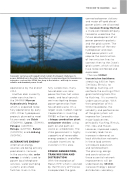
     Sarawak’s vast area and rugged terrain remain the biggest challenges to power distribution in the state. Nevertheless, heavy investment in transmission networks - such as this 275kV line deep in the interior - will help to ensure reliable and abundant power for all.
connected power stations and major off-grid diesel- power plants are all owned by Sarawak Energy Berhad, a State-controlled company tasked to undertake the future development of all power generating plants and the grid system. The development of the new hydropower and coal-
fired power plants will require the construction
of transmission lines to connect then to the State’s grid system, which will also have to be reinforced and expanded.
The new 500kV transmission backbone, stretching 490 km from Similajau, Bintulu, to Tondong, Kuching, will reinforce the existing 275kV grid stretching from Miri
to Kuching. It is currently under construction. With the completion of this 500kV backbone, the reliability and performance of the grid system will improve for Sarawak’s major load centres, principally Kuching, Bintulu, Miri, Sibu and Mukah. However, improved supply invariably leads to an increase in demand, so local distribution networks in these load centres
will require expansion
and reinforcement.
The planning, design
and construction of
these essential network improvements will be undertaken by SESCO, Sarawak Energy’s power distribution subsidiary.
operational by the end of 2014.
Another dam currently under construction is
the 944MW Murrum Hydroelectric Project, which is expected to be fully operational by early 2015. Other hydropower projects planned to meet future needs are Baleh (1300MW), Lawas, (50MW), Pelagus (440MW),
Belaga (220MW), Baram (1200MW) and Limbang (160MW).
ALTERNATIVE ENERGY
Alternative energy sources are being actively promoted in Sarawak.
In the countryside, solar energy is widely used to power local telephone services, water pumping systems and school facilities. Even in the
fully wired cities, many households use solar power for their hot water needs, and local councils are investigating biogas power generation from household waste. On a larger scale, Carbon Capital Corporation is investing RM180 million to develop
a biogas production plant and power station, using palm oil and palm oil waste as a feedstock. The state government is highly supportive of renewable energy projects and offers valuable incentives to investors in this area.
POWER GENERATION, TRANSMISSION AND DISTRIBUTION
With the exception of Bakun HPP, which is owned by the Ministry of Finance Incorporated, the grid-


