


Page 70 - The Guide To Sarawak
P. 70
 68
THE PEOPLE
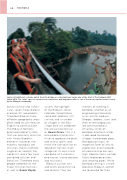
  Ladies in traditional costume watch from the bridge as contestants get under way at the start of the Padawan Raft Safari 2014. The safari, open to experienced competitors and beginners alike, is one of the most popular events hosted by the Bidayuh community.
Bukar-Sadong and Salako- Lara), seven major dialects and over 30 sub-dialects. Therefore Bidayuh from different geographic areas often need to use Malay or English to communicate. The Bidayuh formerly practised a belief system that was primarily animistic with Hindu-Buddhist elements. However, the majority nowadays are Christian, mostly Catholic, Anglican or Seventh Day Adventist, and a few have converted to Islam and Baha’iism. Therefore most people celebrate all the major Christian festivals,
as well as Gawai Dayak,
usually the highlight
of the Bidayuh social calendar. Nevertheless, some old traditions still survive, and a number
of villages in the Bau- Singai area still celebrate the annual rice festival
or Gawai Sa’wa. This is a remarkable shamanistic ritual to appease the plant and animal spirits and thank the rice spirit for an abundant harvest. Each village has its own ritual, complete with shamans, priestesses, trance dancers and musicians.
Bidayuh culture, arts and crafts are distinctive and diverse. They are
masters of working in bamboo, whether as an engineering material or
as an artistic medium. Bridges, ladders, stairs and even entire longhouses
are constructed out
of various kinds of bamboo, and fresh water
is delivered to remote villages via bamboo pipes. Bamboo carving is an important form of artistic expression, and standards of workmanship are very high. Popular items include flutes, blowpipe quivers and smoking pipes. While bamboo carving is a male preserve, Bidayuh women are renowned for their


