


Page 68 - The Guide To Sarawak
P. 68
 66
THE PEOPLE
     The Bidayuh
By Y Bhg Datuk Peter Minos
ORIGIN AND HISTORY
The Bidayuh are the fourth largest ethnic group in Sarawak, with a population of 204,000, making up 8% of the state’s population. During the Brooke and Colonial eras, they were known as Land Dayaks
(the Dayak, or people, of the hill country). They are believed to be indigenous to Borneo, originating
from the interior of West Kalimantan, although some legends claim descent from the Srivijaya and Majapahit Empires of Java. Their own oral history suggests they migrated to Sarawak any
time between 1,200 and 2,500 years ago. However, some researchers believe the migration began in the mid-14th Century.
Prior to the political demarcations carried out by the Brookes and the Dutch in the 1830’s and 40’s, the Land Dayak of Sarawak
and Kalimantan were not seen as distinct. However, after the drawing up of formal borders, the Land Dayak of Sarawak became separated from their peers in Kalimantan. The Bidayuh of Sarawak consist of the Bukar-Sadong, Biatah, Bau-Jagoi and Salako-
Lara groupings, basically differentiated by language (see below). The Bukar- Sadong of Serian District
came from Retoi, the Biatah of Penrissen and Padawan districts from Sungkong, whilst the Salako-Lara came from Batang Kapuas and settled in Tanjong Datu.
The Bidayuh are a peaceful people and were subject
to a fugitive way of life, always suffering constant harassment by Malays of rank, Iban headhunters and pirates. Despite suffering these long and severe hardships, the people were able to hold onto their lowland settlements until Rajah Sir James Brooke brought peace to Southwest Sarawak from 1841 onwards. Nowadays, Bidayuh settlements can be found throughout Lundu, Bau , Kuching and Serian districts.
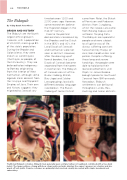
    Tradtional Bidayuh costumes. Bidayuh men generally wear a simple turban or headband, combined with a tree-bark jacket. The large necklace, strung with bear claws and boar tusks, displays the owner’s prowess as a hunter and also wards off evil spirits. Female costumes are primarily black and red, usually decorated with simple beadwork and embroidery.


