


Page 89 - The Guide To Sarawak
P. 89
THE GUIDE TO SARAWAK
87
     The Kedayan
By Tuan Haji Alias Bin Mail
ORIGIN AND HISTORY
The Kedayan Community trace their ancestry from Javanese migrants who settled in Brunei and intermarried with Brunei Malays during the golden decades of the Brunei Sultanate.
Sultan Bolkiah (1473- 1521) invited a contingent of Javanese to teach their advanced farming methods and assist Brunei, then heavily dependent on rice imports, to develop the local agricultural sector. Their success led to them remaining in and around Brunei and many of them married local Brunei Malays. They originally dwelled in Temburong, Tutong, Jerudong, Muara and Belait and they later moved to the nearby states of Sarawak and Sabah and the island of Labuan. Today, Kedayan communities are found from Beaufort to Sindumin and in Sipitang (southern Sabah), and in Labuan, Merapok, and along the coast from Lawas to Kampung Jepak, Bintulu (northern Sarawak). Their main occupation remains farming (planting padi), although in Brunei and
the Limbang District of Sarawak they are also involved in fishing and trading. They mostly live along the coastal areas.
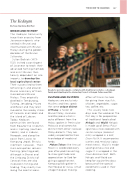
Ready to welcome guests, complete with traditional costume - a Kedayan family participating in the Homestay Project at Sungai Peliau near Miri.
CULTURE AND CUSTOMS
Kedayans are exclusively Muslims and they speak
the same unique dialect
of Malay, a fusion of
Brunei Malay, Javanese
and Banjarese which is quite different from the Malay spoken in Peninsular Malaysia and somewhat distinct from other Sarawak Malay dialects. They are widely respected for their knowledge of medicinal herbs.
Makan Tahun (the Annual Feast) is celebrated every year after padi harvesting, to show gratitude and appreciation to God for giving a good harvest. Kampung folk gather in
the Mosque or Surau (small village mosque) making
offers of thanks to God for giving them rice, fish, chicken, vegetables, sugar, tea, coffee, etc.
This usually takes two days over the weekend. The first day is for preparation of traditional food called Kelupis and Wajid. Kelupis is made up of Beras Pulut (glutinous rice) cooked with santan kelapa (coconut milk) wrapped in a leaf, Daun Nyi’ik. It accompanies curries and rendang (spicy meat stews). Wajid is made up of glutinous rice and sugar. It is wrapped in the Daun Bemban leaf. Both Kelupis and Wajid can
keep for a quite few days because of the special condiments used in their cooking.


