


Page 79 - The Guide To Sarawak
P. 79
THE GUIDE TO SARAWAK
77
   Penan
The Penan are found in
the undulating hinterland between the floodplains
and the highland areas such as the upper Baram and Limbang River and their tributaries, Belaga District, Bintulu District, and in
the Suai-Niah area of Miri District. They are divided into two dialect groups, Eastern and Western Penan. The Eastern Penan are believed to originate from East Kalimantan in central Borneo, and the Western Penan from the Usun Apau Plateau, in Belaga District. Formerly nomadic, the majority of Penan have settled down over the
last century. However, approximately 400 people in the Tutoh and Limbang watersheds remain nomadic.
Although small in number, the Tagal have been able to retain a distinct identity because of their geographic isolation.
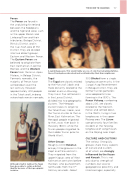
A vanishing people. This Lisum family are one of only four remaining families, the rest having been absorbed and acculturated by their Iban neighbours.
   Tagal
The Tagal are closely related to the Murut of Sabah and more distantly related to the Kelabit and Lun Bawang. They live in five settlements in the Lawas District, divided into two geographic clusters. The Merapok cluster traces its origin to the Tahol River, Sabah, and the Trusan cluster to the Lo River, East Kalimantan. The Merapok people migrated
to the Lawas river basin in the early 1800’s while the Trusan people migrated to the middle Trusan prior to World War II.
Other Groups
Roughly 2,000 Beketan occupy 13 longhouses in the Kapit and Tatau districts. They migrated from the upper Kapuas area of West Kalimantan centuries before the Iban, who pushed them northwards from the 17th Century onwards. About
300 Bhuket form a single longhouse community in the Sungai Asap Resettlement in Belaga District. They are former hunter-gatherers who adopted hill rice farming in the 1930’s. The Punan Vuhang, numbering about 200, are closely related to the Western Penan and settled down
in the 1960’s, living in two longhouses in the upper Rejang area. The Lisum comprise only four families resident at the Tanjong longhouse of Long Pawah, on the Rejang near Kapit.
CULTURE AND CUSTOMS
The various Orang Ulu groups share many aspects of culture and custom,
all of which are strongly influenced by the Kayan and Kenyah. This is not only due to strength of numbers, but also to geographical proximity and intermarriages, especially


