


Page 81 - The Guide To Sarawak
P. 81
THE GUIDE TO SARAWAK
79
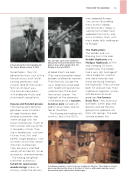
         A Kenyah warrior photographed in the Upper Baram region in 1912.
Nevertheless, they still observe festivals such as the Kenyah pusau anak (child naming ceremony) and melado (end of the harvest festival) or lepah ajau,
(the Kenyah equivalent) with elaborate rituals and chanting of sacred texts.
Kajang and Related groups
The Kajang were formerly gatherers and cultivators
of sago. However, due
to long association and intermarriage with the Kayan and Kenyah, much of their culture and way of life is nowadays similar. They live in longhouses, cultivate hill rice, hunt, fish, and collect jungle products such as rattan which they weave into mats and baskets.
They are also a stratified society of aristocrats, minor aristocrats, and commoners.
The Kajang are gifted craftsmen and artists, famed for spectacular woodcarvings known as klirieng, where the remains
The lute-like sape is the definitive Orang Ulu musical instrument. These players were photographed in Ulu Rejang in the late 1950’s.
of dead chiefs are kept. They are also excellent boat builders and basket weavers. Their festivals include the save’, originally associated with headhunting and now used to mark the end of
the harvest season. The highlight of the ceremony
is the erection of a wooden kelaman pole carved with eight human faces, one on top of the other.
The Kajang are traditionally animists, but in the 1950’s
they adopted Bungan
(see above), discarding many animist taboos
and restrictions. Today, a substantial number have adopted Christianity and
a tiny minority, Islam, with many older folks holding on to Bungan.
The Highlanders
The Kelabit and Lun Bawang live in the cool Kelabit Highlands and Maligan Highlands, of Miri and Limbang Divisions, respectively. The Kelabit
had a very rich heritage of stone megaliths, menhirs and stone mounds and these are found littered in the highlands. They cultivate both hill and wet rice. Their traditional irrigation system, refined over centuries, produces the famous
Bario Rice. They also raise buffaloes, cattle, pigs and poultry, and are the only groups that produce salt from salt springs. The cool climate enables the
  A Sekapan woman cooks rice in her longhouse kitchen. The bamboo stored above and below the stove is the fuel of choice, although nowadays most households have switched to bottled gas.


