


Page 84 - The Guide To Sarawak
P. 84
 82
THE PEOPLE
 musicians, with possibly the best gamelan ensembles in Sarawak.
Traditionally animists,
the majority of Bisaya are nowadays Christians, and many traditional practices, such as healing rituals,
are no longer observed. However, traditional
values such as respect for individuals, caring for the elderly, mutual help, and co- operation are retained.
Penan
The nomadic Penan live
in bands, comprising 5
to 7 families or 30 to 40 individuals, staying in camp huts, which they abandon
in their cyclical migration from one resource site to another. The settled Penan live in longhouses or a village made up of individual houses. Each band or village has a headman (pengaja’u uma’), above whom is the (penghulu) who looks after several villages within a designated area.
Similar to other communities, the boundaries between villages are well defined
and follow streams, ridges and other landmarks. All village activities such as farming, hunting, gathering of forest products, fishing and so forth, are allowed within these boundaries.
In the case of the Penan,
it is called tana’ pengurip. When one tana’ pengurip overlaps with another, the groups involved use the area collectively. Settled Penan cultivate part of their tana’ pengurip, mainly through
hill paddy farming, and gather resources from the remainder. Those Penan who settled in the lowland regions of Bintulu and Miri Divisions in the late 19th and early 20th Century cultivate cash crops such as pepper, cocoa and rubber. In addition, some of them have ventured into oil palm planting, benefiting from modern infrastructure and access to markets.
The Penan are arguably
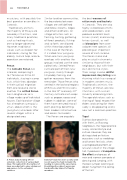
Elderly Penan men were a rarity until recent years, the hard nomadic life leading to reduced life expectancy. Everything the subject wears was handcrafted by himself of family members.
the best weavers of
rattan mats and baskets
in Sarawak. They are also highly skilled blacksmiths and woodworkers, and produce excellent bush knives (malat) and carving knives (penat), as well
as blowpipes from over
a dozen tree species, all providing an important source of cash income.
The Penan make and
play musical instruments similar to those of their neighbours, but with their own distinctive styles.
Their songs involve skillful improvised storytelling and rhyming which has no equal in modern western music. Traditionally animists, the majority of Penan are now Christians, with a small minority embracing Islam. The age-old values such as sharing of food, respect for elders and caring for them sadly is disappearing and is now not a common practice.
Tagal
Due to close proximity
with their Lun Bawang neighbours, the Tagal practice a very similar lifestyle and culture. However, they are distinguished on festive occasions such as weddings and harvest festivals, when
a springboard platform or lansaran is built in the village hall. It produces a trampoline- like effect and groups of
men and women compete at dancing and jumping, with the best jumper catching an object hung from the ceiling of the hall.
      A Penan lady showing off her extensive collection of ear pendant rings. Throughout life the number of rings are adjusted to give a balanced appearance to the extended earlobes.


