


Page 64 - The Guide To Sarawak
P. 64
 62
THE PEOPLE
 The Chinese
By Senator Prof Dr Sim Kui Hian, K. C. Jong and Ong Liang Yong
Origin and History
Chinese traders came to Sarawak in the 6th Century but only settled down in large numbers from the early 19th Century. Others came from Pontianak, West Borneo in the 1840’s-50’s, mostly Hakkas who had come to mine for gold
at Bau, a small village near Kuching. They had previously migrated from
Kwangtung to escape foreign rule in China.
Two other groups arrived via Singapore in the mid-19th Century; the Hokkiens from Fukien and the Teochews from Swatow. The two groups engaged in a struggle for power, as both worked in the grocery and rubber trades, acting as middlemen between rural producers and exporters in major ports. Eventually the Hokkiens gained the upper hand in the financial world.
Early Chinese leaders
Hakka Gold Miners from the Mau San Kongsi at Bau in the early 1850’s.
included Lau Chek, a Cantonese, who came
in 1830; Ong Ewe Hai, a Hokkien, from Singapore in 1846; Chan Kho, a Ch’aoan in 1850, and Law Kian Huat, a Teochew in 1852. In 1901, 1,070 Foochows led by the Reverend Wong Nai Siong were recruited from Fujian Province by Rajah Charles Brooke for pioneering agricultural activities in the Rejang basin. Henghuas, Cantonese, Hainanese
and Luichows made up
the balance of Sarawak’s Chinese.
The dialect-based economic activities of
the Chinese community remained unchanged
until the early 1980’s. Coffeeshops and restaurants were operated by the Hainanese. Bicycles and motorcycles were repaired by the Henghuas who also went into fishing with their ‘kotaks’ (wooden fishing vessels). The Teochews
and Hokkiens dominated
the general trades and finance. Vegetable and
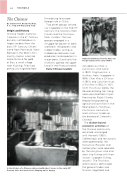
       In the kitchen of a Chinese rubber smallholder’s house in the early 20th Century. Note the latex sheets hanging up for drying.


